
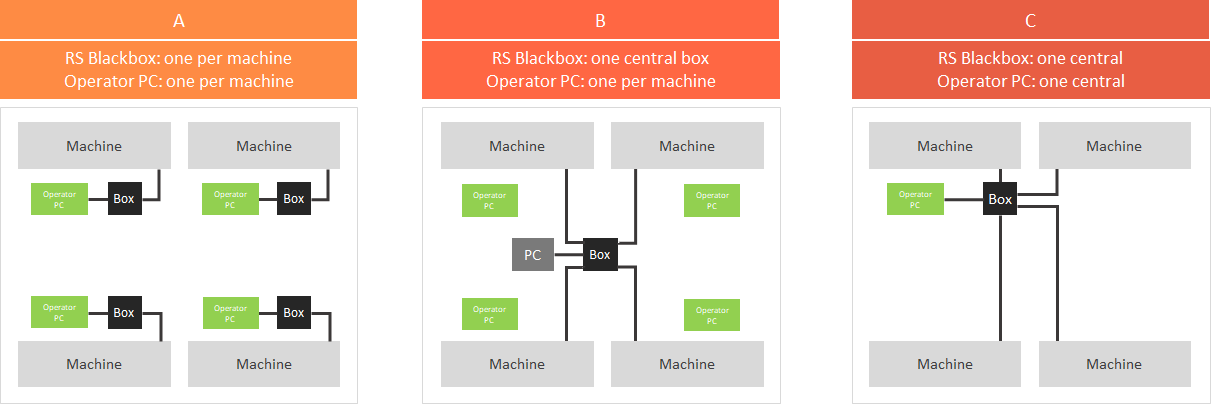
A - One piece of hardware per machine
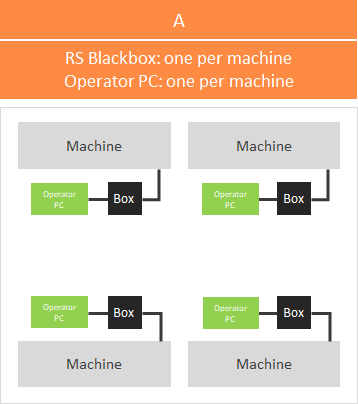
4 x Measure point
4 x RS IoT
4 x PC for logging and Operator tools
Advantages
-
User interface very close to where operators runs the machine/station
-
Operator tools has instant access to machine data even without connection
to the central server and real time data is therefor not at all depending on
infrastructure like database/server/network -
Easy to document, support and maintain hardware connection and setup
-
No risk that power shut down on one machine effects the data collection
at another machine
Risks
-
No known risks
B - One central RS IoT and local Operator tools PC for each measure point
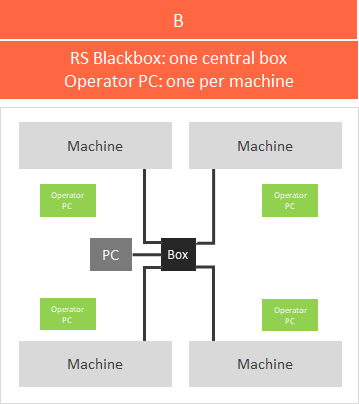
4 x Measure point
1 x RS Blackbox
4 x PC for Operator tools
1 x PC for logging machine signals
Advantages
-
User interface very close to where operators runs the machine/station
-
Easy to overview all machine signals on one central spot
-
Possible to maintain the logging PC without disturbing the Operator
tools PCs -
Reduces hardware costs
Risks
-
Problems with network/sever/database will effect the real time
updates on the Operator tools clients.
C - One central RS IoT and one central Operator tools PC for several measure points
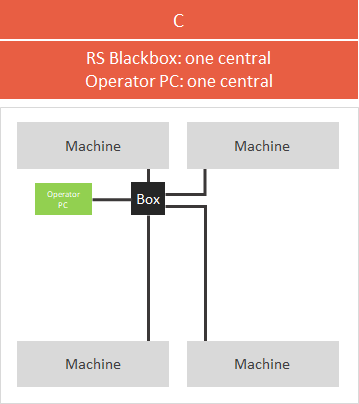
4 x Measure point
1 x RS IoT
1 x PC for logging and Operator tools
Advantages
-
Easy to overview all machine signals on one central spot
-
Maximum reduction of hardware costs
Risks
-
Operators don’t have Operator tools available on all machines and must
remember to go to the central Operator tools client -
Problems with network/sever/database will effect the real time updates
on the Operator tools clients.